> For the complete documentation index, see [llms.txt](https://docs.airops.com/llms.txt). Markdown versions of documentation pages are available by appending `.md` to page URLs; this page is available as [Markdown](https://docs.airops.com/actions/workflow-concepts/workflow-steps/ai-steps/llm/choosing-a-model.md).
# Model Selection Guide
Compare supported models and choose one for a Prompt LLM step
## Choose a Model
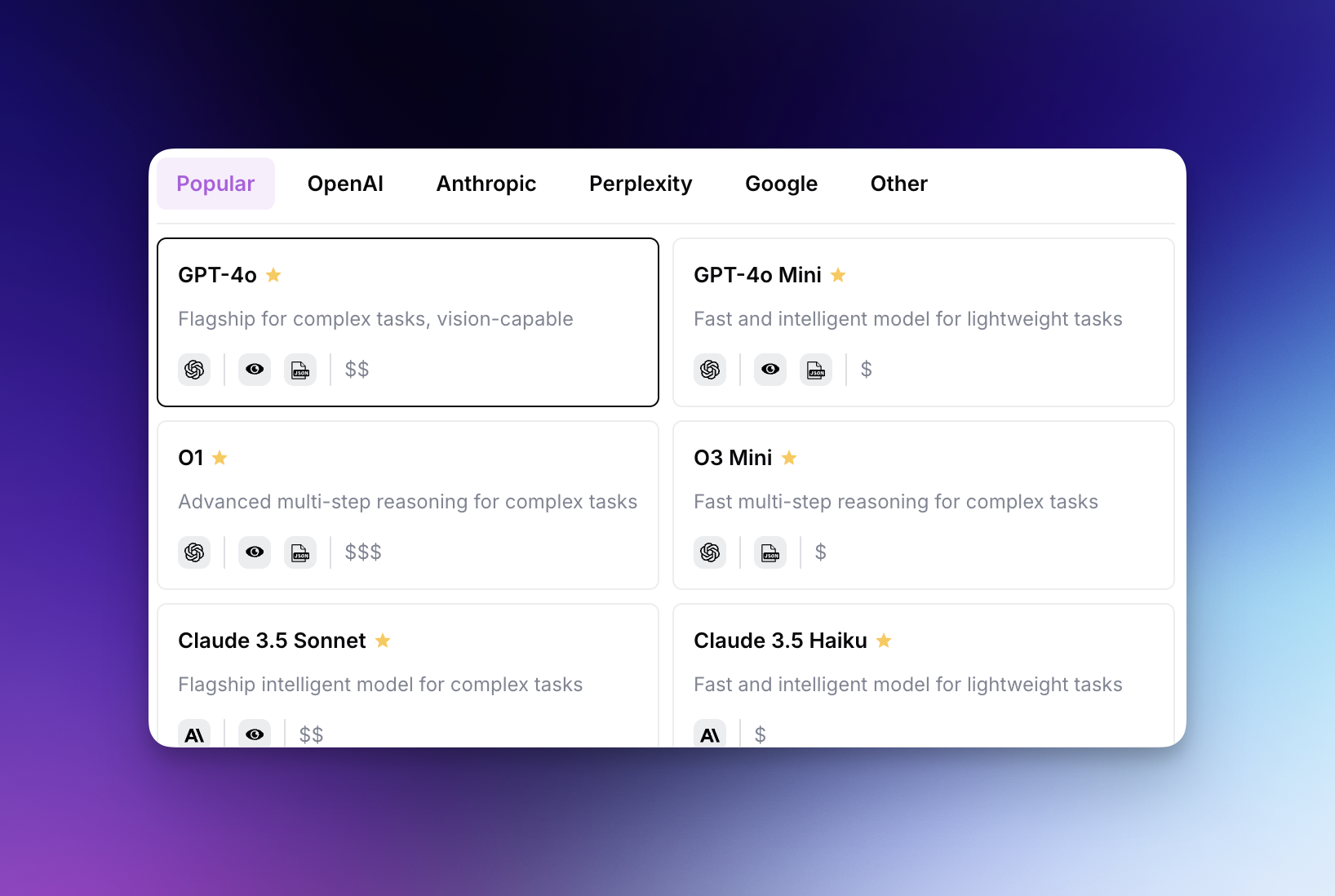
The model you select affects output quality, speed, cost, and the features available in a [Prompt LLM step](/actions/workflow-concepts/workflow-steps/ai-steps/llm.md). Use the model picker as the source of truth for availability in your workspace.
### What to Consider
Compare these factors before selecting a model:
1. **Context window:** Check how much input the model can process. One token is roughly four characters in English.
2. **Task complexity:** Use stronger reasoning models for planning, analysis, and multi-step logic.
3. **Web access:** Confirm that the model supports web research when the task needs current information.
4. **Cost:** Compare the model's cost tier in the picker, especially for high-volume Workflows.
5. **Speed:** Balance response time against the reasoning depth the task requires.
## Common AirOps Models
The following models cover common use cases in new Workflows. A checkmark means the capability is available in the AirOps Prompt LLM step.
| Model | Provider | Description | Context Window | Vision | JSON Mode | Web Access |
| ---------------------- | ---------- | ----------------------------------------------------------- | -------------- | ------ | --------- | ---------- |
| GPT-6 Astra | OpenAI | Complex reasoning and agentic work | 1M | ✓ | ✓ | ✓ |
| GPT-6.1 Sol | OpenAI | Default for new Prompt LLM steps | 1M | ✓ | ✓ | ✓ |
| GPT-6 Sol | OpenAI | Strong reasoning for coding and agentic work | 1M | ✓ | ✓ | ✓ |
| GPT-6 Luna | OpenAI | Efficient model for focused, high-volume work | 1M | ✓ | ✓ | ✓ |
| GPT-5.6 Sol | OpenAI | Flagship GPT-5.6 model for complex reasoning and coding | 1M | ✓ | ✓ | ✓ |
| GPT-5.6 Terra | OpenAI | Balanced GPT-5.6 model for strong performance at lower cost | 1M | ✓ | ✓ | ✓ |
| GPT-5.6 Luna | OpenAI | Cost-efficient GPT-5.6 model for high-volume workloads | 1M | ✓ | ✓ | ✓ |
| GPT-5.5 | OpenAI | Previous flagship for complex reasoning tasks | 1M | ✓ | ✓ | ✓ |
| GPT-5.4 | OpenAI | Advanced model for professional work | 1M | ✓ | ✓ | ✓ |
| GPT-5.4 Mini | OpenAI | Faster GPT-5.4 model for well-defined tasks | 400K | ✓ | ✓ | ✓ |
| GPT-5.2 | OpenAI | Flagship with enhanced long-context reasoning | 400K | ✓ | ✓ | ✓ |
| GPT-5 | OpenAI | Model for complex tasks | 200K | ✓ | ✓ | ✓ |
| O3 Pro | OpenAI | Advanced model for complex reasoning | 200K | ✓ | ✓ | - |
| O3 | OpenAI | Reasoning model with web research | 200K | ✓ | ✓ | ✓ |
| Claude Opus 5.5 | Anthropic | Complex reasoning and agentic work | 1M | ✓ | - | ✓ |
| Claude Opus 5 | Anthropic | For complex agentic coding and enterprise work | 1M | ✓ | - | ✓ |
| Claude Fable 5.1 | Anthropic | Demanding reasoning and long-horizon agentic work | 1M | ✓ | - | ✓ |
| Claude Fable 5 | Anthropic | Demanding reasoning and long-horizon agentic work | 1M | ✓ | - | ✓ |
| Claude Sonnet 5.5 | Anthropic | Fast model for coding and everyday tasks | 1M | ✓ | - | ✓ |
| Claude Sonnet 5 | Anthropic | Hybrid reasoning for fast answers or deep thinking | 1M | ✓ | - | ✓ |
| Claude Opus 4.8 | Anthropic | Previous flagship for complex multi-step tasks | 1M | ✓ | - | ✓ |
| Claude Opus 4.7 | Anthropic | Complex reasoning, coding, and long-context work | 1M | ✓ | - | ✓ |
| Claude Opus 4.6 | Anthropic | Complex reasoning and coding | 200K | ✓ | - | ✓ |
| Claude Sonnet 4.6 | Anthropic | Current Sonnet option for complex tasks | 200K | ✓ | - | ✓ |
| Claude Haiku 5.5 | Anthropic | Fast classification, extraction, and lightweight tasks | 1M | ✓ | - | ✓ |
| Claude Haiku 4.5 | Anthropic | Fast model for lightweight tasks | 200K | ✓ | - | ✓ |
| Gemini 3.8 Flash | Google | Reasoning and generation with Google Search grounding | 1M | - | ✓ | ✓ |
| Gemini 3.5 Flash | Google | Fast model with Google Search grounding | 1M | - | ✓ | ✓ |
| Gemini 3.1 Pro Preview | Google | Advanced reasoning with Google Search grounding | 1M | - | ✓ | ✓ |
| Gemini 3 Flash Preview | Google | Fast model for lightweight tasks | 1M | - | ✓ | ✓ |
| Gemini 3.1 Flash Lite | Google | Cost-efficient model for lightweight tasks | 1M | - | ✓ | ✓ |
| Perplexity Sonar | Perplexity | Balanced model for online web research | 128K | - | - | ✓ |
## OpenAI Models
### GPT-6 Astra
Select **GPT-6 Astra** for complex reasoning and agentic tasks. It supports reasoning effort, verbosity, vision, JSON output, and web research in the Prompt LLM step. Temperature controls are unavailable.
### GPT-6.1 Sol
New Prompt LLM steps default to **GPT-6.1 Sol** with **Medium** reasoning effort. You can choose **Low**, **Medium**, or **High**. The step supports vision, JSON output, Web Research, and verbosity controls, with a 1M-token context window and up to 128,000 output tokens. Temperature controls are unavailable. Existing supported model selections remain unchanged.
### GPT-6 Sol and Luna
Use **GPT-6 Sol** for demanding coding, reasoning, and agentic work. **GPT-6 Luna** is a lower-cost option for focused, high-volume tasks.
Both support vision, JSON output, Web Research, reasoning effort, and verbosity controls. Temperature controls are unavailable. Existing steps keep their selected model.
### GPT-5 Series
GPT-5 models combine reasoning with general-purpose generation. GPT-5.6 appears in the model picker as Sol, Terra, and Luna. These models remain available for existing and new steps.
Reasoning controls vary by model:
* GPT-5 supports `minimal`, `low`, `medium`, and `high`.
* GPT-5.1, GPT-5.2, GPT-5.4, GPT-5.5, and GPT-5.6 support `none`, `low`, `medium`, and `high`.
### O3 Models
Use O3 for complex, multi-stage reasoning. O3 supports `low`, `medium`, and `high` reasoning levels. O3 Pro increases reasoning capability but does not support web research in the Prompt LLM step.
## Differences between Claude Models
### Claude Opus 5.5
Select **Claude Opus 5.5** for complex reasoning and agentic work. It supports a 1M-token context window, vision, and Web Research. Turn on **Enable Thinking** to use adaptive thinking. Temperature controls and Web Fetch are unavailable for this model in the Prompt LLM step.
### Claude Opus 5
Claude Opus 5 handles complex agentic coding and enterprise work. Turn on **Enable Thinking** in the Prompt LLM step when the task benefits from additional reasoning. Claude Opus 5 supports **Web Research**, but it does not support **Web Fetch**.
### Claude Fable 5.1 and Fable 5
Claude Fable 5.1 supports demanding reasoning and long-horizon agentic work, with a 1M-token context window, vision, adaptive thinking, Web Research, and Web Fetch. Fable 5 remains available for existing Workflows.
### Claude Sonnet 5.5
Select **Claude Sonnet 5.5** for coding and everyday tasks. It supports a 1M-token context window, vision, Web Research, and Web Fetch. Turn on **Enable Thinking** to use adaptive thinking with Low, Medium, or High effort. Temperature controls are unavailable.
### Claude Sonnet 5
Claude Sonnet 5 balances fast responses with deeper reasoning and is starred in the LLM model picker.
### Claude Opus 4.8 and 4.7
Claude Opus 4.8 and 4.7 support complex, multi-step Workflows, long-form content, and research tasks. Both models support 1M-token context windows.
### Claude Haiku 5.5
Select **Claude Haiku 5.5** in a Prompt LLM step for classification, extraction, and lightweight tasks. It supports vision, Web Research, a 1M-token context window, and up to 128,000 output tokens.
Turn on **Enable Thinking** for adaptive thinking with **Low**, **Medium**, or **High** effort. Temperature, Top P, Top K, and Priority Tier controls are unavailable for this model.
### Claude Sonnet 4.6 and Haiku 4.5
Use Claude Sonnet 4.6 for complex tasks that need a balance of reasoning and speed. Use Claude Haiku 4.5 for lighter workloads.
## Gemini Flash models
Gemini 3.8 Flash supports a 1M-token context window, JSON output, and Google Search grounding. Vision and MCP tools are unavailable for this model in the Prompt LLM step. Gemini 3.8 Flash does not expose temperature controls.
## Groq models
Select **GPT OSS 120B** or **GPT OSS 20B** for open-weight models hosted by Groq. GPT OSS 20B is intended for lighter tasks.
Groq retired Llama 3.1 8B Instant and Llama 3.3 70B Versatile on August 16, 2026. AirOps maps affected selections to GPT OSS 20B and GPT OSS 120B, respectively. Review and test the replacement before running an affected Workflow in bulk.
## Model Availability
AirOps hides deprecated models from the picker for new Workflows. If an existing Workflow uses a deprecated model, the selected model remains visible so you can review the change. AirOps may automatically update the selection to a supported model when the Workflow loads. If a replacement has also been deprecated, AirOps follows the replacement chain to a supported model.
Review the selected model and test the Workflow after an automatic update. Model behavior, cost, and supported settings can change between versions.
### Scheduled model replacements
AirOps' configured replacement schedule includes:
| Deprecated model | Replacement | Scheduled removal |
| --------------------- | --------------------- | ----------------- |
| GPT-5.4 Nano | GPT-6 Luna | April 1, 2027 |
| GPT-5.1 | GPT-6 Sol | April 1, 2027 |
| Claude Sonnet 4.5 | Claude Sonnet 5.5 | November 30, 2026 |
| Gemini 3.7 Flash | Gemini 3.8 Flash | January 28, 2027 |
| Gemini 2.5 Flash Lite | Gemini 3.1 Flash Lite | October 20, 2026 |
| Gemini 2.5 Flash | Gemini 3.8 Flash | October 20, 2026 |
| Gemini 2.5 Pro | Gemini 3.1 Pro | October 20, 2026 |
Claude Opus 4.1's configured removal date was August 5, 2026; its replacement is Claude Opus 4.8. Test affected Workflows with the replacement model before running them in bulk.
## Web Search Capabilities
Several models support web research, allowing them to access current information during generation:
**OpenAI:** GPT-6 Astra, GPT-6.1 Sol, GPT-6 Sol, GPT-6 Luna, GPT-5, GPT-5.2, GPT-5.4, GPT-5.4 Mini, GPT-5.5, GPT-5.6 Sol, GPT-5.6 Terra, GPT-5.6 Luna, and O3 support web research when enabled in the Prompt LLM step.
**Anthropic:** Current Claude models support web research. Web Fetch availability depends on the selected model. Claude Opus 5.5 and Opus 5 support **Web Research**, but not **Web Fetch**.
**Google:** Current Gemini models support web research through Google Search grounding.
**Perplexity:** Sonar models include web access for online research.
## How much will it cost to run?
The cost to run a model depends on the number of input and output tokens.
### Token Approximation
**Input tokens:** to approximate the total input tokens, copy and paste your system, user, and assistant prompts into [the OpenAI tokenizer](https://platform.openai.com/tokenizer)
**Output tokens:** to approximate the total output tokens, copy and paste your output into [the OpenAI tokenizer](https://platform.openai.com/tokenizer)
### Cost Approximation
**OpenAI:** divide the input and output tokens by 1000; then multiply by their respective costs [based on OpenAI pricing](https://openai.com/pricing)\*
**Anthropic:** divide the input and output tokens by 1,000,000; then multiply by their respective costs [based on Anthropic pricing](https://www-cdn.anthropic.com/files/4zrzovbb/website/31021aea87c30ccaecbd2e966e49a03834bfd1d2.pdf)\*
{% hint style="info" %}
\*This is the cost if you [bring your own API Key](/your-workspace/settings/byo-key.md). If you choose to use AirOps hosted models, you will be [charged tasks according to your usage](https://airopshq.notion.site/AirOps-Task-Pricing-by-Hosted-Service-fd825db1300545cb8c3b5de8bc16529e).
{% endhint %}
---
# Agent Instructions
This documentation is published with GitBook. GitBook is the documentation platform designed so that both humans and AI agents can read, navigate, and reason over technical content effectively. Learn more at gitbook.com.
## Querying This Documentation
If you need additional information that is not directly available in this page, you can query the documentation by asking a question.
Perform an HTTP GET request on the following URL with the `ask` and `goal` query parameters:
```
GET https://docs.airops.com/actions/workflow-concepts/workflow-steps/ai-steps/llm/choosing-a-model.md?ask=&goal=
```
`ask` is the immediate question: it should be specific, self-contained, and written in natural language.
`goal` is what the user is ultimately trying to achieve, the reason they need the answer. Sharing it helps GitBook give you a better, more relevant answer. A goal is most helpful when it describes the outcome the user wants rather than restating the question. For example, with `ask=how do I create an API token`, a goal like `automate deployments from our CI pipeline` lets GitBook tailor the answer to that use case.
The response will contain a direct answer to the question and relevant excerpts and sources from the documentation.
Use this mechanism when the answer is not explicitly present in the current page, you need clarification or additional context, or you want to retrieve related documentation sections.