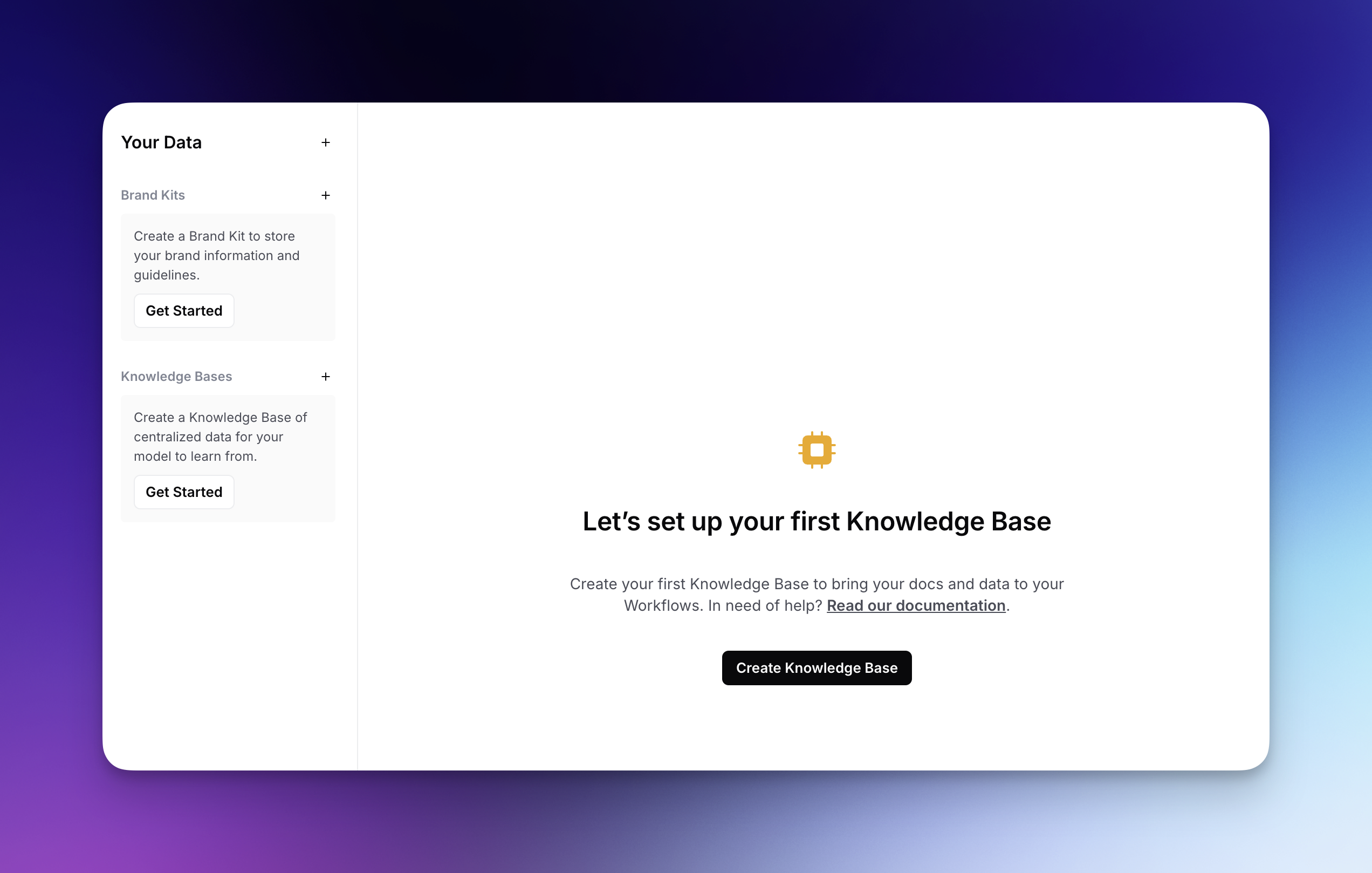
> For the complete documentation index, see [llms.txt](https://docs.airops.com/llms.txt). Markdown versions of documentation pages are available by appending `.md` to page URLs; this page is available as [Markdown](https://docs.airops.com/context/memory-stores.md).
# Knowledge Bases
Semantically search your knowledge, documents, and data with Knowledge Bases
## What is a Knowledge Base?
Knowledge Bases allow you to store and selectively retrieve context from larger bodies of relevant information, greatly improving the quality of your LLM outputs. By importing structured and unstructured data (such as blog content, product catalogs, internal documentation, or customer support materials) you can provide your LLM-powered workflows with deeper context and unlock higher quality responses.
You can import data from a variety of sources, including file uploads (PDFs, CSVs, text documents, images), web scraping, Google Drive, SQL databases, and Shopify.
At the core of Knowledge Bases is Semantic Search, a powerful retrieval method that returns the most similar content based on meaning rather than just keyword matching. This means that even if your query isn’t an exact match, AirOps can still find and surface related content. For example, if you’re writing an article on chocolate desserts, the system might retrieve content on chocolate cakes, different types of chocolate, and even related dessert recipes, helping you enrich your prompts with the most useful and contextually relevant information.
## Creating a Knowledge Base
Setting up a Knowledge Base is easy. All you need to have ready is your content so you can upload it:
{% @arcade/embed url="" flowId="67THPCPcj05izgdtQssL" %}
---
# Agent Instructions
This documentation is published with GitBook. GitBook is the documentation platform designed so that both humans and AI agents can read, navigate, and reason over technical content effectively. Learn more at gitbook.com.
## Querying This Documentation
If you need additional information that is not directly available in this page, you can query the documentation by asking a question.
Perform an HTTP GET request on the following URL with the `ask` and `goal` query parameters:
```
GET https://docs.airops.com/context/memory-stores.md?ask=&goal=
```
`ask` is the immediate question: it should be specific, self-contained, and written in natural language.
`goal` is what the user is ultimately trying to achieve, the reason they need the answer. Sharing it helps GitBook give you a better, more relevant answer. A goal is most helpful when it describes the outcome the user wants rather than restating the question. For example, with `ask=how do I create an API token`, a goal like `automate deployments from our CI pipeline` lets GitBook tailor the answer to that use case.
The response will contain a direct answer to the question and relevant excerpts and sources from the documentation.
Use this mechanism when the answer is not explicitly present in the current page, you need clarification or additional context, or you want to retrieve related documentation sections.