> For the complete documentation index, see [llms.txt](https://docs.airops.com/llms.txt). Markdown versions of documentation pages are available by appending `.md` to page URLs; this page is available as [Markdown](https://docs.airops.com/docs/fr/actions/workflow-concepts/workflow-steps/image-and-video.md).
# Image et vidéo
Les étapes Image et Vidéo permettent de puissantes capacités de création et de manipulation de contenu visuel dans vos workflows AirOps.
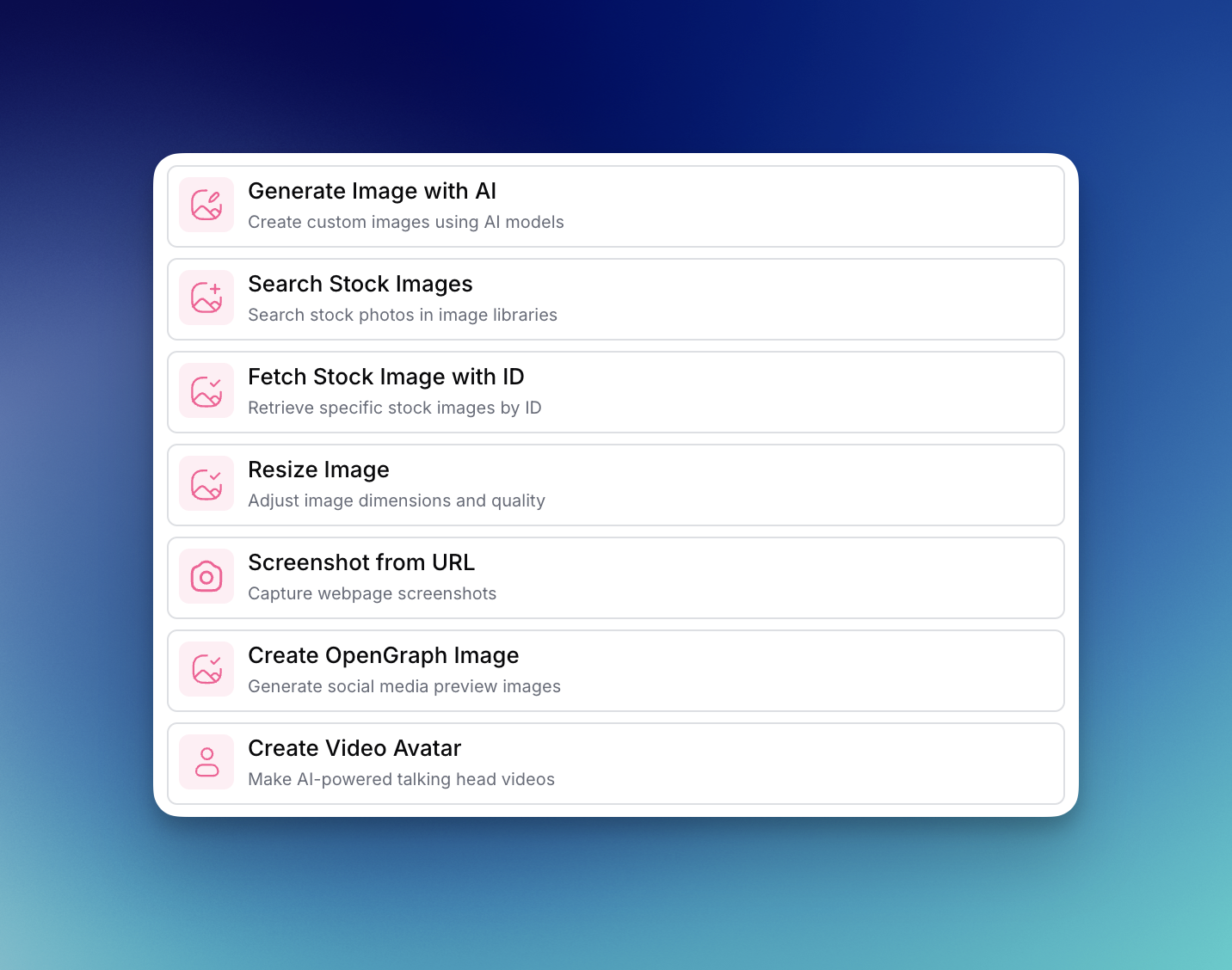
Ces étapes vous permettent de générer, rechercher et modifier des ressources visuelles qui rendent votre contenu plus engageant. Les étapes Image et Vidéo incluent :
1. [**Générer une image avec l’IA** ](/docs/fr/actions/workflow-concepts/workflow-steps/image-and-video/image-generation-step.md)-- créer des images personnalisées à l’aide de modèles d’IA comme GPT Image, Nano Banana Pro et Stable Diffusion
2. [**Rechercher des images de stock**](/docs/fr/actions/workflow-concepts/workflow-steps/image-and-video/search-stock-images.md) -- trouver des photos de stock pertinentes pour votre contenu
3. [**Récupérer une image de stock avec son ID**](/docs/fr/actions/workflow-concepts/workflow-steps/image-and-video/fetch-stock-image-with-id.md) -- récupérer des images de stock spécifiques à l’aide de leurs identifiants uniques
4. [**Redimensionner l’image**](/docs/fr/actions/workflow-concepts/workflow-steps/image-and-video/resize-image.md) -- ajuster les dimensions et la qualité de l’image pour répondre à vos besoins
5. [**Capture d’écran à partir d’une URL**](/docs/fr/actions/workflow-concepts/workflow-steps/image-and-video/screenshot-from-url.md) -- capturer des captures d’écran de n’importe quelle page web
6. [**Créer une image OpenGraph**](/docs/fr/actions/workflow-concepts/workflow-steps/image-and-video/create-opengraph-image.md) -- générer des images de prévisualisation personnalisées pour les réseaux sociaux afin d’améliorer l’engagement
7. [**Créer un avatar vidéo**](/docs/fr/actions/workflow-concepts/workflow-steps/image-and-video/create-video-avatar.md) -- produire des vidéos de type tête parlante alimentées par l’IA pour un contenu personnalisé
Ces étapes peuvent être combinées avec d’autres fonctionnalités d’AirOps pour automatiser les workflows de contenu visuel.
---
# Agent Instructions
This documentation is published with GitBook. GitBook is the documentation platform designed so that both humans and AI agents can read, navigate, and reason over technical content effectively. Learn more at gitbook.com.
## Querying This Documentation
If you need additional information that is not directly available in this page, you can query the documentation by asking a question.
Perform an HTTP GET request on the following URL with the `ask` and `goal` query parameters:
```
GET https://docs.airops.com/docs/fr/actions/workflow-concepts/workflow-steps/image-and-video.md?ask=&goal=
```
`ask` is the immediate question: it should be specific, self-contained, and written in natural language.
`goal` is what the user is ultimately trying to achieve, the reason they need the answer. Sharing it helps GitBook give you a better, more relevant answer. A goal is most helpful when it describes the outcome the user wants rather than restating the question. For example, with `ask=how do I create an API token`, a goal like `automate deployments from our CI pipeline` lets GitBook tailor the answer to that use case.
The response will contain a direct answer to the question and relevant excerpts and sources from the documentation.
Use this mechanism when the answer is not explicitly present in the current page, you need clarification or additional context, or you want to retrieve related documentation sections.