> For the complete documentation index, see [llms.txt](https://docs.airops.com/llms.txt). Markdown versions of documentation pages are available by appending `.md` to page URLs; this page is available as [Markdown](https://docs.airops.com/docs/es/acciones/workflow-concepts/workflow-outputs.md).
# Resultados del flujo de trabajo
Define cómo quieres renderizar la salida de un flujo de trabajo
## ¿Cómo defino cómo se renderizará la salida?
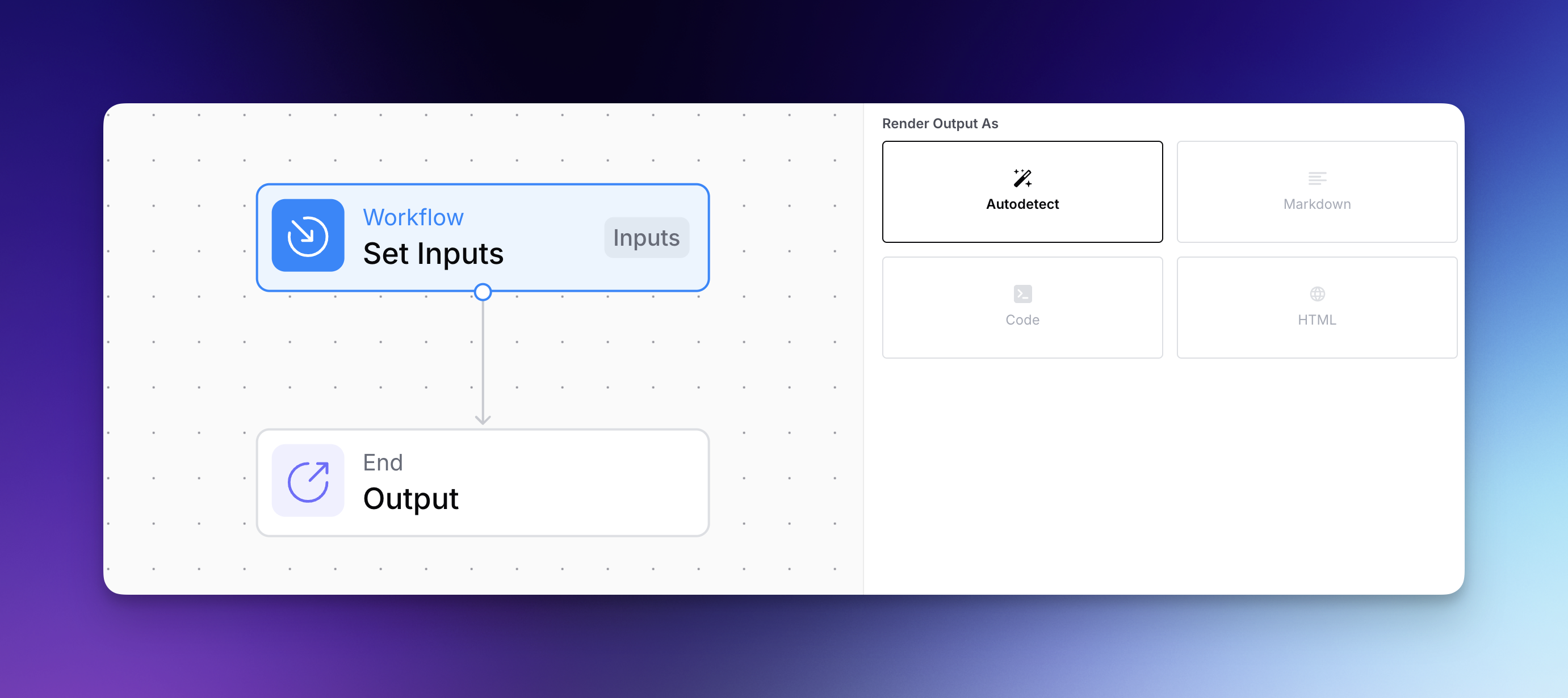
Como parte de la configuración del nodo Final de tu flujo de trabajo, puedes seleccionar cómo renderizar el texto.
De forma predeterminada, el sistema detectará automáticamente el tipo de renderizado según el contenido de la salida.
## Tipos de renderizado compatibles
Actualmente se admiten los siguientes tipos de renderizado:
1. **Markdown:** Admite formato de texto, enlaces e imágenes para una presentación de texto enriquecido.
2. **Código:** Muestra código con el formato adecuado y resaltado de sintaxis.
3. **HTML:** Renderiza el contenido HTML como un visor de página web.
## Salida única vs. múltiple
Puedes alternar fácilmente entre los modos de salida única y salida múltiple directamente en la configuración del paso Final. No se requiere ningún paso JSON.
* **Salida única:** Devuelve un valor de tu flujo de trabajo. Ideal para flujos de trabajo simples que producen una sola pieza de contenido.
* **Salida múltiple:** Devuelve múltiples valores con nombre de tu flujo de trabajo. Usa esto cuando necesites generar varias piezas distintas de datos (p. ej., título, cuerpo, descripción meta).
Para cambiar entre modos, haz clic en el interruptor del panel de configuración del paso Final. Al usar salida múltiple, puedes definir varios campos de salida, cada uno con su propio nombre y tipo de renderizado.
---
# Agent Instructions
This documentation is published with GitBook. GitBook is the documentation platform designed so that both humans and AI agents can read, navigate, and reason over technical content effectively. Learn more at gitbook.com.
## Querying This Documentation
If you need additional information that is not directly available in this page, you can query the documentation by asking a question.
Perform an HTTP GET request on the following URL with the `ask` and `goal` query parameters:
```
GET https://docs.airops.com/docs/es/acciones/workflow-concepts/workflow-outputs.md?ask=&goal=
```
`ask` is the immediate question: it should be specific, self-contained, and written in natural language.
`goal` is what the user is ultimately trying to achieve, the reason they need the answer. Sharing it helps GitBook give you a better, more relevant answer. A goal is most helpful when it describes the outcome the user wants rather than restating the question. For example, with `ask=how do I create an API token`, a goal like `automate deployments from our CI pipeline` lets GitBook tailor the answer to that use case.
The response will contain a direct answer to the question and relevant excerpts and sources from the documentation.
Use this mechanism when the answer is not explicitly present in the current page, you need clarification or additional context, or you want to retrieve related documentation sections.