> For the complete documentation index, see [llms.txt](https://docs.airops.com/llms.txt). Markdown versions of documentation pages are available by appending `.md` to page URLs; this page is available as [Markdown](https://docs.airops.com/docs/de/aktionen/workflow-concepts/application-inputs.md).
# Workflow-Eingaben
Definieren Sie die UI- und API-Eingabewerte für Ihre Workflows
So fügen Sie Eingabevariablen hinzu
Workflow-Eingaben sind Variablen, die Sie zur Laufzeit festlegen und innerhalb Ihrer Workflows verwenden können.
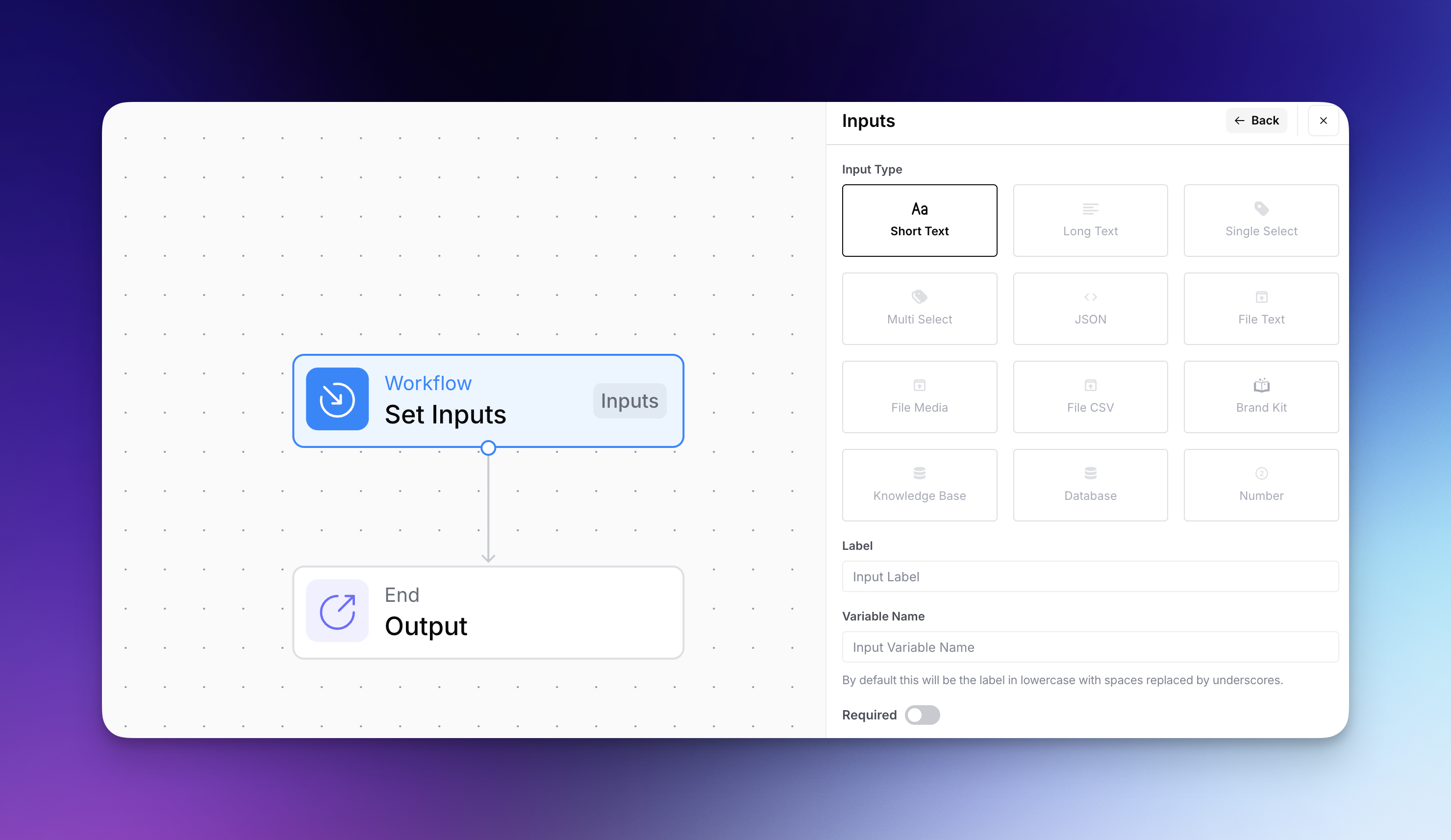
### 1. Klicken Sie auf die **"Konfigurieren"** Schaltfläche in Ihrem Start-Schritt
Klicken Sie auf "Eingaben festlegen", um Ihre Eingaben zu definieren
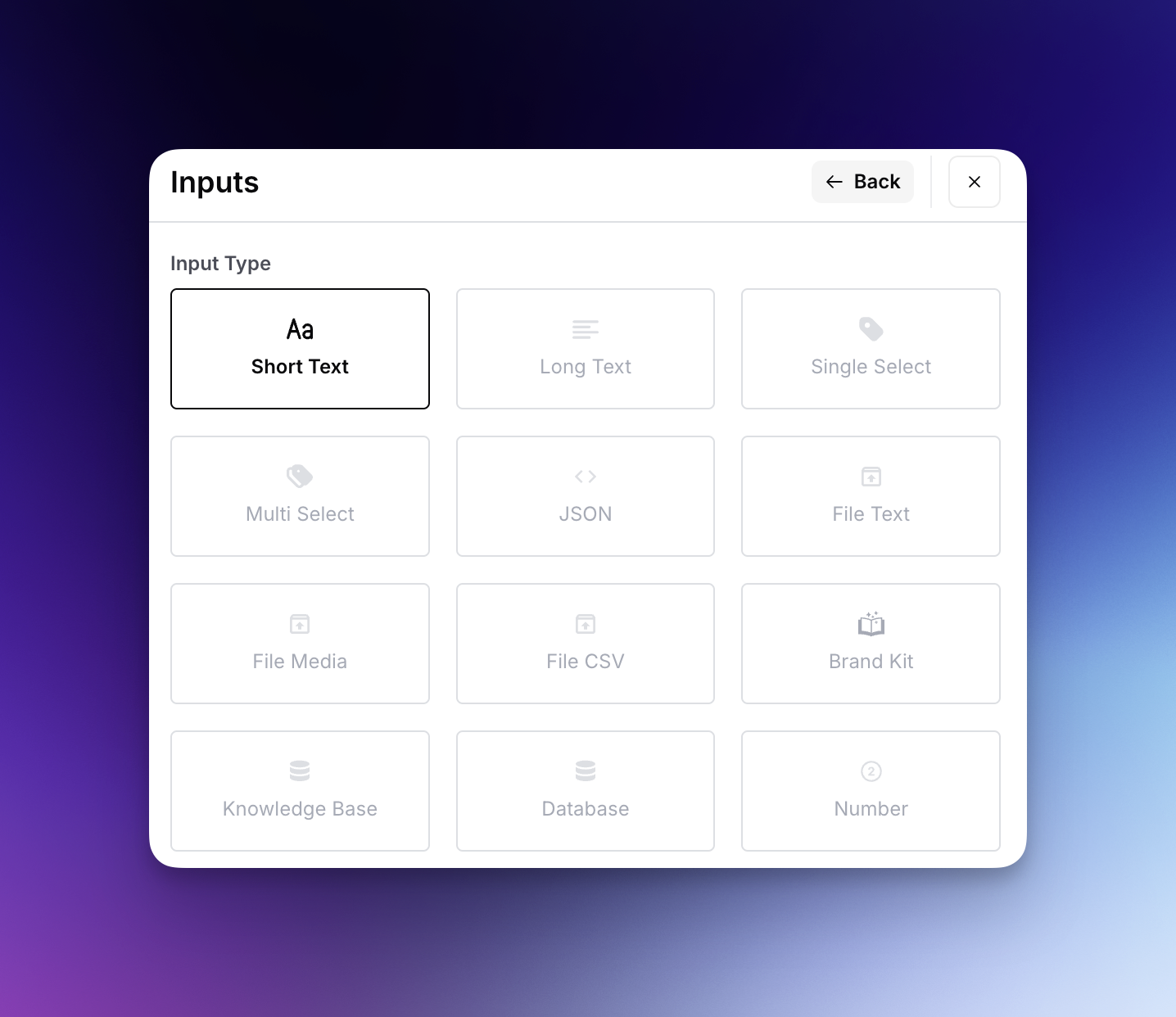
### 2. Wählen Sie Ihren Eingabetyp aus
Sie werden zunächst aufgefordert, Ihren gewünschten **"Eingabetyp"** auszuwählen. Dies bestimmt sowohl die Benutzeroberfläche als auch den Datentyp Ihres Eingabewerts:
### 3. Passen Sie das Eingabefeld an
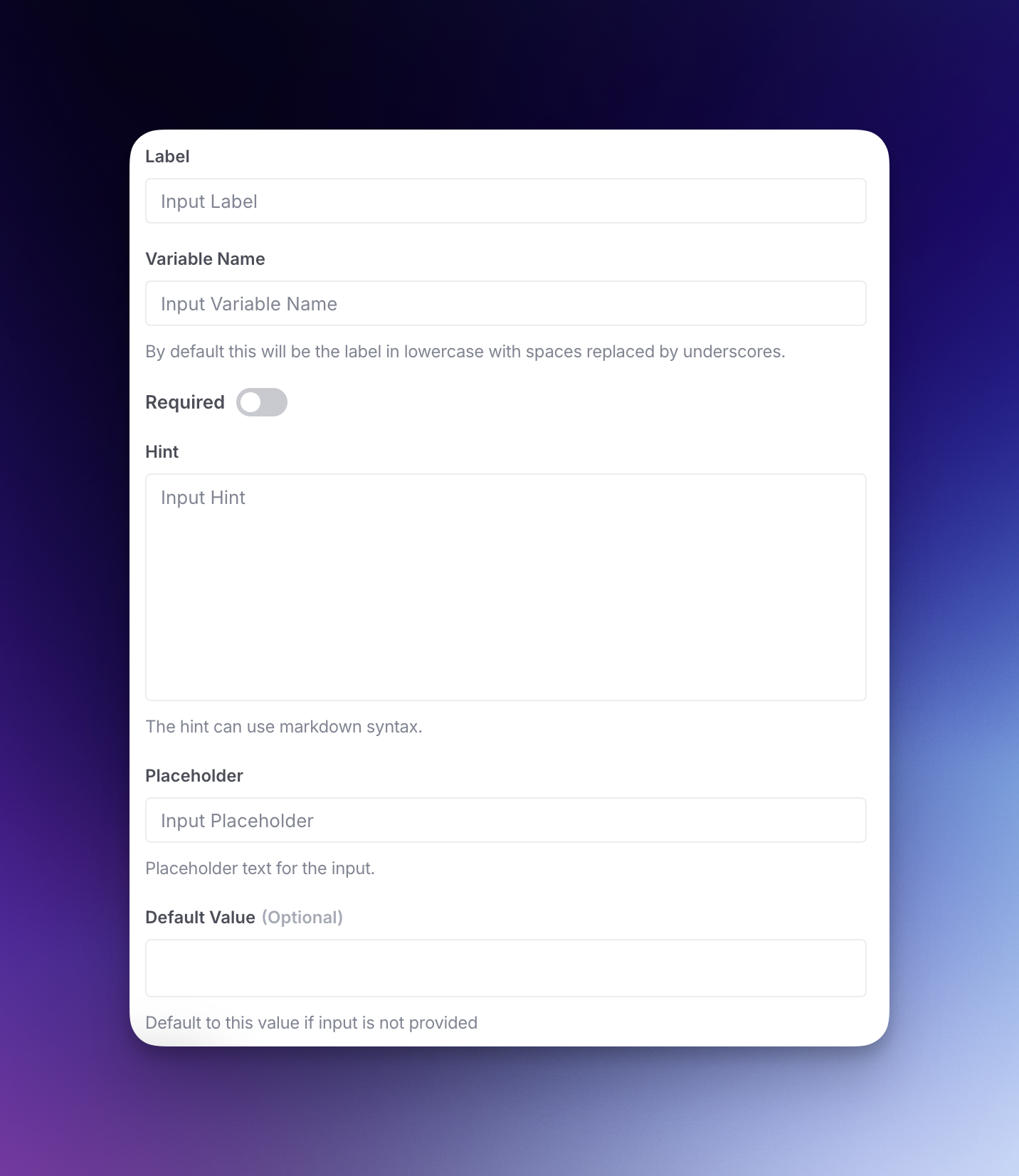
Siehe den [nächsten Abschnitt](#input-types) für eine vollständige Liste der unterstützten Typen, um zu entscheiden, was für Ihren Anwendungsfall am besten geeignet ist. Fahren Sie fort, die restlichen Felder Ihrer Workflow-Eingabe auszufüllen:
* **Beschriftung:** eine beschreibende Bezeichnung für den Namen Ihrer Eingabe
* **Variablenname:** der Name Ihrer Eingabe als Variable, auf die in Ihren Schritten als Liquid-Syntax verwiesen wird. Standardmäßig wird der Variablenname automatisch generiert, wenn Sie eine Beschriftung hinzufügen, kann aber separat angepasst werden
* **Hinweis:** Hilfetext, der unter Ihrer Eingabe auf der Workflow-Seite angezeigt wird
* **Platzhalter:** Beispielwert, der durch Ihren Eingabewert überschrieben wird
* **Standardwert:** ein Standardwert, der verwendet wird, wenn kein anderer Eingabewert angegeben wird; dies ist nützlich für API-Aufrufe
* **Erforderlich:** bestimmt, ob die Eingabe erforderlich ist, damit Ihr Workflow erfolgreich ausgeführt werden kann
{% hint style="info" %}
**Eingaben sind standardmäßig erforderlich.** Wenn Sie eine neue Eingabe erstellen, wird sie automatisch als erforderlich festgelegt. Dadurch sparen Sie bei der Erstellung von Workflows einen Klick pro Eingabe. Sie können die Option "Erforderlich" deaktivieren, wenn Sie eine Eingabe optional machen möchten.
{% endhint %}
---
# Agent Instructions
This documentation is published with GitBook. GitBook is the documentation platform designed so that both humans and AI agents can read, navigate, and reason over technical content effectively. Learn more at gitbook.com.
## Querying This Documentation
If you need additional information that is not directly available in this page, you can query the documentation by asking a question.
Perform an HTTP GET request on the following URL with the `ask` and `goal` query parameters:
```
GET https://docs.airops.com/docs/de/aktionen/workflow-concepts/application-inputs.md?ask=&goal=
```
`ask` is the immediate question: it should be specific, self-contained, and written in natural language.
`goal` is what the user is ultimately trying to achieve, the reason they need the answer. Sharing it helps GitBook give you a better, more relevant answer. A goal is most helpful when it describes the outcome the user wants rather than restating the question. For example, with `ask=how do I create an API token`, a goal like `automate deployments from our CI pipeline` lets GitBook tailor the answer to that use case.
The response will contain a direct answer to the question and relevant excerpts and sources from the documentation.
Use this mechanism when the answer is not explicitly present in the current page, you need clarification or additional context, or you want to retrieve related documentation sections.